
Medically Reviewed by Dawn Wahezi, MD, MS on January 26, 2026. Cure JM shares family experiences to support informed conversations between families and their care teams.
Access to home infusion can vary based on factors such as geography, insurance, and caregiver support. The National Home Infusion Association has published helpful insights on how social determinants of health influence patient experiences in home infusion settings. Read the full article here.
Intravenous immunoglobulin (IVIG) is a common treatment for juvenile myositis and other autoimmune conditions. IVIG can be administered in different settings, including hospitals, infusion centers, or at home, depending on a patient’s medical needs, insurance coverage, and care team recommendations.
Who this resource is for: Families who are learning about IVIG and want to better understand what home infusions can look like from a family perspective.
The experience of IVIG can vary widely from family to family. This family’s perspective on receiving IVIG at home is offered to help other families understand what this option can look like in practice. The following story shares one child’s experience receiving IVIG at home with the support of a dedicated nurse. Families should always consult their care team to determine what is appropriate for their child when making treatment decisions.
Rooney’s Story (Patient Perspective)
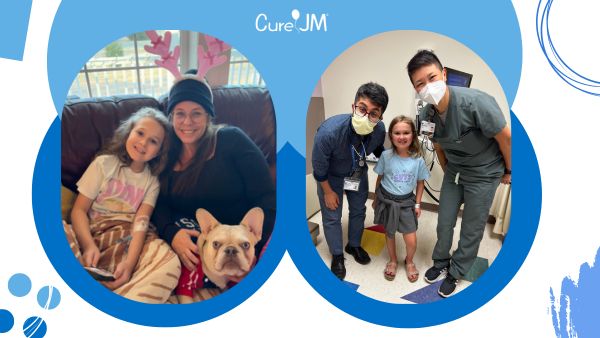
“My name is Rooney, I am 9 years old, and I have Juvenile Dermatomyositis (JDM). Because of my JDM, I have to have ten-hour IVIG, every six weeks (*IVIG is not the same for every family. Some children receive it every four weeks, while others may need it more or less often. The schedule is usually anywhere from one to six weeks. Your care team will help create a plan that works best for your child.*) When I first started my treatments, I did them in the hospital and then in an infusion center. I hated them. It was a very long day and I was in a small room and couldn’t walk around. It was boring and uncomfortable. It felt like I was sick. We decided to try them at home and I got to meet my Katie. Katie is the best nurse I have ever met and I have met a lot of nurses. My infusions are very long and most kids (and grownups) would not like doing them. Katie makes it so fun that I can’t wait for my next treatment. I literally can’t wait. She is so fun, nice, funny, and takes such good care of me. She doesn’t just give me an IV and sit and wait for the time to take it out. If I ever don’t feel good, she knows how to make me feel better right then. She plays with me, we go on adventures in my yard, and she brings me surprises and crafts for us to do together. We play Roblox together, take selfies, and play with my dolls. Katie tells me all about what she is doing so I know what is happening to me. I have learned a lot from her. Katie is not just a great nurse, she is one of my favorite people on Earth, and one of my best friends. I am so lucky that she takes care of me.” -Rooney, JDM Patient
A Parent Q&A: Megan on Her Family’s IVIG Journey
Megan, Rooney’s mom, reflects on their family’s experience with IVIG.
Question: Megan, can you share a little about Rooney’s treatment journey and how IVIG fits into it?
Megan: Sure. Rooney receives IVIG as part of her treatment plan for juvenile myositis. Like many families, we started with infusions at the hospital. Over time, our care team suggested trying IVIG at home as an option, and we decided to give it a try to see if it would work better for our family. Our drive to the IVIG clinic was quite long, so we thought this was a good alternative for us to try.
Question: What was the biggest difference you noticed when you transitioned from hospital-based IVIG to home IVIG?
Megan: The biggest difference was the overall stress level. Instead of packing up, driving to the hospital, dealing with parking, waiting rooms, and long infusion days, the nurse comes to our home. That alone has made the day feel calmer and more manageable for Rooney and for our whole family.
Question: How does the medication and administration differ for you at home?
Megan: For us personally, the medication and administration are the same. Rooney receives IVIG through an IV infusion, just as she did at the hospital. At home, we still have a bag of medication and a trained nurse who comes to administer the infusion.
Question: How has home IVIG affected Rooney’s experience specifically?
Megan: Rooney is much more relaxed at home. She can be in her own space, with her own toys and comforts, and she does not associate the day with a hospital environment. That has made the experience feel less scary for her, especially over time.
Question: How does home IVIG impact the rest of your family?
Megan: It has made a big difference for logistics. There is less time spent in the car and fewer disruptions for siblings. We are not juggling school schedules, childcare, or long days away from home in the same way. It feels less disruptive to our family routine overall.
Question: Were there any concerns or considerations you thought through before deciding to try home IVIG?
Megan: Yes, definitely. We talked with our care team about safety, nursing support, and what would happen if there were any issues during the infusion. We also knew that home IVIG is not the right fit for every family or every patient, and that hospital infusions work very well for many kids, especially in the beginning.
Question: What would you want other families to know as they consider their options?
Megan: I would say that it is very personal. There is no one right answer. Home IVIG has worked well for us and reduced stress, but every family should talk with their medical team about what makes the most sense for their child. It is okay to ask questions and explore options.
Question: Anything else you want to share?
Megan: I would add that it has been such a joy to be interviewed and I have really enjoyed connecting with each of the families that we have met on this journey. We have learned so much from each of you and we are grateful to have so many new friends on this journey with us. This is a community like no other, and we are grateful for it each day.
What Families Should Know When Exploring IVIG Options
IVIG can be an important part of treatment for JM. Like many treatments, it may come with side effects such as headaches, nausea, or fatigue. Understanding a few key considerations can help families feel more prepared.
Key Considerations
Hydration
Staying well-hydrated before, during, and after an infusion may help reduce side effects. Many care teams recommend increasing fluids in the 24 hours before and after treatment.
Infusion Rate
The speed of the infusion can impact how a child feels. Starting slowly and increasing gradually may help minimize reactions, especially during early infusions.
Monitoring
Reactions can occur during or even hours after an infusion. Caregivers should monitor how their child is feeling and communicate any concerns to the care team.
Advocacy
Families are encouraged to ask questions and understand the plan for their child’s infusion, including medications, fluids, and timing.
Exploring IVIG Options
IVIG can be administered in different settings depending on medical guidance, including hospitals, infusion centers, or at home.
Some families find that receiving IVIG at home may reduce logistical stress, such as travel time and disruptions to daily routines. Others may prefer or require hospital or infusion center care, particularly at certain stages of treatment.
Safety, nursing support, and emergency planning are important considerations in any setting. Families should discuss these factors with their care team to determine what is appropriate for their child.
Individualized Care
IVIG protocols and recommendations can vary between providers. Families should work closely with their clinical care team to determine what is appropriate for their child and their specific situation.
Resource and Partner Acknowledgment
This resource is part of Cure JM’s ongoing effort to provide families with educational information about treatment experiences. Cure JM works with a range of clinical partners and service providers to support patient education. Inclusion of this story does not constitute a recommendation or endorsement of any specific provider.