Understanding the Juvenile Dermatomyositis Patient Journey
Juvenile dermatomyositis (JDM) is a rare autoimmune disease that causes inflammation in a child’s muscles and skin. It affects an estimated one to three children per million each year in the United States.
Children may experience muscle weakness, fatigue, pain, and distinctive skin rashes. Because JDM is so rare, families may face delays in diagnosis and difficulty finding clinicians with disease-specific experience.
JDM and Adult Dermatomyositis
JDM and adult dermatomyositis share many symptoms and treatments, but children can experience different complications, including blood vessel damage, calcium deposits called calcinosis, and skin ulceration.
These differences are important when developing and evaluating treatments for children.
An Urgent Treatment Gap
There are currently no FDA-approved therapies specifically for JDM. Physicians rely on medications approved for other diseases or age groups, and treatment response varies from child to child.
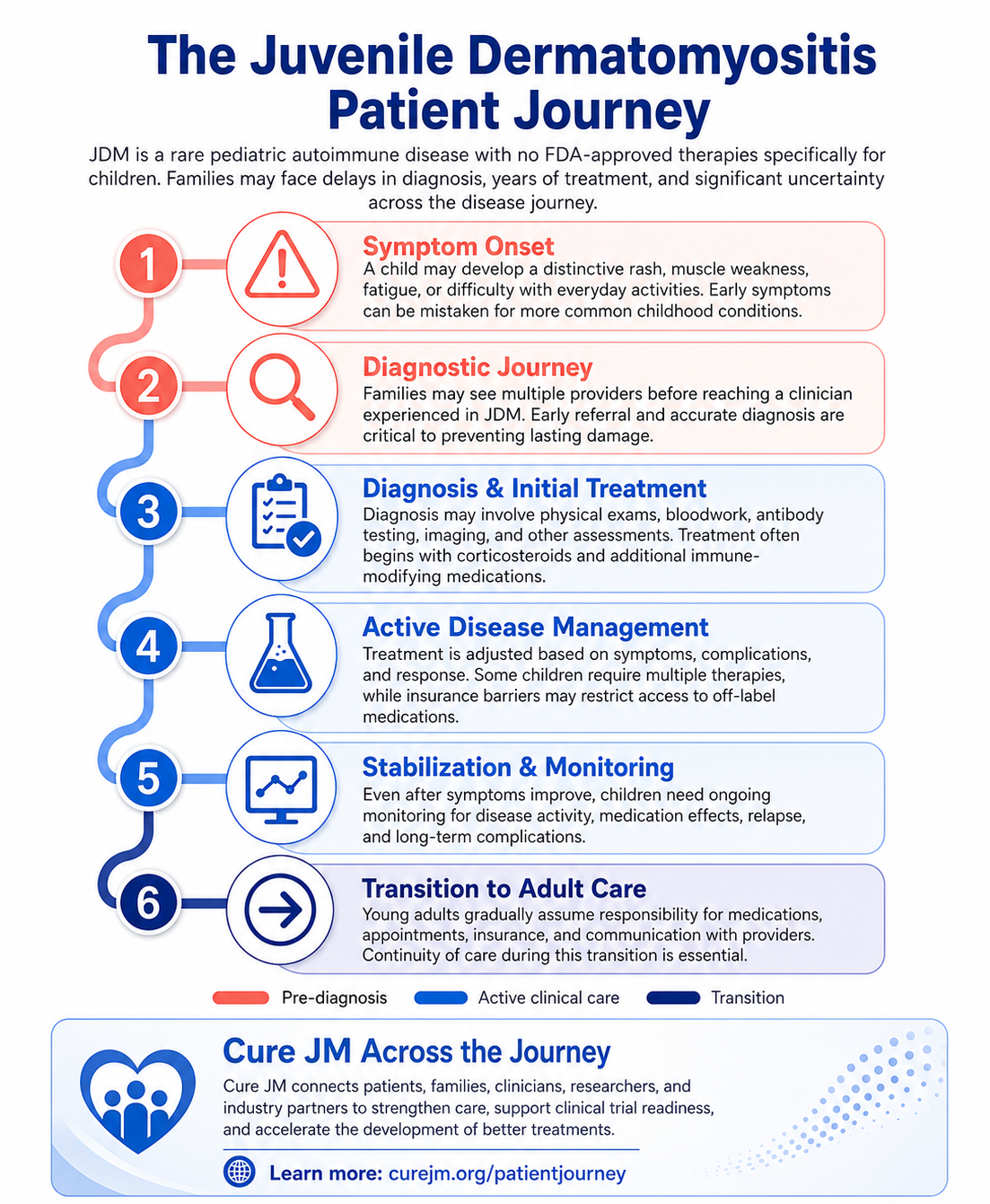
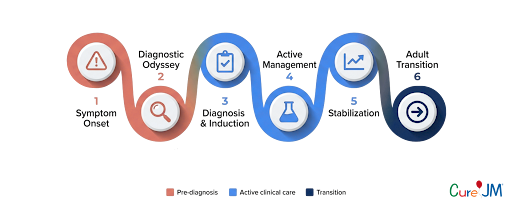
The patient journey below highlights common stages families may experience, from the first symptoms through diagnosis, treatment, long-term monitoring, and transition to adult care.
Stage 1: System Onset
Clinical picture
The most visible early sign of JDM is skin involvement including heliotrope rash, Gottron’s papules, and photosensitivity, often alongside muscle weakness and fatigue. Classic cutaneous findings are considered pathognomonic for diagnosis (Huber et al., Pediatr Rheumatol 2017).
Pain points and unmet needs
Symptoms can resemble more common childhood conditions, and JDM’s rarity means most primary care providers and general pediatricians will see few, if any, cases in their career. Recognition at this stage depends heavily on provider familiarity with a disease they may rarely encounter.
Cure JM touchpoint
The Cure JM Clinical Care Network (CCN) provides a defined referral web of pediatric rheumatology sites with JDM-specific clinical experience, relevant to early case identification and downstream trial referral pathways.
Stage 2: Diagnostic Odyssey
Clinical picture
Myositis-specific antibodies (MSAs) help inform diagnosis and prognosis once a patient reaches a specialist capable of testing for them; rapid referral to a center of experience is recommended, as early and adequate therapy can prevent long-term damage and increase the chance of early remission (Enders et al., Ann Rheum Dis 2017).
Pain points and unmet needs
Evidence-based guidelines have historically been sparse, and management has varied by physician experience and by region, which the SHARE consensus effort was explicitly organized to address in Europe (Enders et al., Ann Rheum Dis 2017). Geographic distance to a center with JDM-specific experience is a distinct and separate access barrier.
Cure JM touchpoint
The CCN currently spans roughly 80 clinicians across approximately 50 institutions in the U.S., Canada, and Europe. It is a mapped population of centers with concentrated JDM caseload relevant to site feasibility and patient identification for trial planning.
Stage 3: Diagnosis & Induction
Clinical picture
Initial treatment of new-onset, moderate JDM follows one of three CARRA consensus treatment plans (CTPs): methotrexate plus prednisone (MP); intravenous methylprednisolone, methotrexate, and prednisone (MMP); or the same combination with added intravenous immunoglobulin (MMPI) (Lindsley et al., Arthritis Care Res 2010; CTP labels per Kim et al., J Rheumatol 2021).
Pain points and unmet needs
In a CARRA registry pilot validation study of these three CTPs (n=39), only 44% of patients achieved moderate improvement at 6 months across all three plans combined, with no statistically significant difference in outcome between them (Kim et al., J Rheumatol 2021). This is a direct, citable unmet-need data point: current standard-of-care induction leaves the majority of patients short of moderate improvement at six months.
Cure JM touchpoint
The CCN’s shared clinical resource infrastructure (core-set-measure documentation, standardized assessment templates) supports consistent outcome capture from this stage forward and is relevant to any partner needing comparable baseline and induction-phase data across sites.
Stage 4: Active Disease Management: Consensus Treatment Plans
Clinical picture
Beyond induction, CARRA CTPs branch by phenotype rather than following a single escalation ladder: New-onset, moderate JDM (initial treatment): three CTPs — MP, MMP, MMPI (Lindsley et al., Arthritis Care Res 2010).
Beyond the first two months: a follow-up CARRA conference established consensus steroid-tapering protocols at a two-month checkpoint, adjusted by whether the patient is improved, unchanged, or worse (Huber et al., Arthritis Care Res 2012).
Persistent skin rash after initial treatment: for patients already on methotrexate and corticosteroids whose muscle symptoms have improved but rash persists, three CTPs — intravenous immunoglobulin, mycophenolate mofetil, or cyclosporine (Huber et al., J Rheumatol 2017;44(1):110-116).
Skin-predominant JDM at new onset (amyopathic / JDM sine myositis): three CTPs — hydroxychloroquine alone; hydroxychloroquine plus methotrexate; or hydroxychloroquine, methotrexate, and corticosteroids (Huber et al., Pediatr Rheumatol 2017).
Refractory moderate JDM (biologic escalation): CARRA’s biologic-agent CTPs for refractory disease remain in development rather than finalized publication — the framework was presented as a conference abstract building on methodology described by Spencer et al. (2017) (Sherman, Kim, Tarvin, Arthritis Rheumatol 2022 [abstract]).
This is the gap in the published consensus framework most relevant to where a new biologic could enter care.
A separate European consensus, SHARE, published its own diagnosis and treatment recommendations with 7 overarching principles, 33 diagnosis recommendations, and 19 treatment recommendations, each accepted at greater than 80% expert agreement (Enders et al., Ann Rheum Dis 2017). SHARE was developed for and validated within European practice; applicability to North American care pathways has not been clinically established and should not be assumed.
Outside the published CTP framework, CCN clinician-reported prescribing shows increasing use of JAK inhibitors with 82% of surveyed CCN clinicians (n=17) having prescribed tofacitinib, with baricitinib, upadacitinib, and ruxolitinib also in use including for calcinosis, a debilitating and treatment-resistant JDM complication not directly addressed by the published CTPs.
Pain points and unmet needs
100% of surveyed CCN clinicians identify insurance navigation as the single biggest barrier to prescribing JAK inhibitors, and step therapy is a specifically documented barrier for rare-disease patients where treatments are often off-label. More fundamentally, the published CTP framework directs care by phenotype but does not resolve access barriers to the medications it specifies. The biologic/refractory-disease CTP, arguably the most relevant segment for a new therapy’s entry point, remains unfinished in the published literature.
Cure JM touchpoint
The CCN has developed a Letters of Medical Necessity resource addressing the insurance-navigation barrier documented above, and its clinician network overlaps substantially with the CARRA JDM committee authorship driving the CTP framework itself. This is relevant to engagement on where a new therapy could be incorporated into future consensus guidance. Cure JM also runs an ongoing Clinical Trial Readiness training for principal investigators and research coordinators, covering trial infrastructure, outcome-measure licensing, and pediatric consent/assent dynamics , intended to keep site-level research capacity developing alongside the clinical care described above.
Stage 5: Stabilization & Monitoring
Clinical picture
Longer-term steroid management follows the CARRA consensus tapering protocol from the two-month follow-up CTP (Huber et al., Arthritis Care Res 2012). Ongoing monitoring uses core outcome measures (CMAS and MMT-8) within a Treat-to-Target framework. In the published T2T cohort, 100% of eligible patients achieved steroid reduction to below 0.3 mg/kg/day at a median of 11.24 months, and 94.74% achieved muscle remission at a median of 5.57 months (Rosina et al., Curr Rheumatol Rep 2023, as cited in CCN clinical intelligence).
Pain points and unmet needs
The field lacks a validated, consensus definition of remission in JDM, even as T2T and the CARRA tapering framework both provide interim benchmarks, an open methodological gap relevant to defining trial endpoints.
Cure JM touchpoint
Cure JM funds JDM patient registries and biorepositories at CARRA and Lurie Children’s Hospital, which represent an existing longitudinal data and biospecimen resource relevant to natural history study design or external control data.
Stage 6: Pediatric-to-Adult Transition
Clinical picture
Transition to adult care is a recognized high-risk period: gaps in care during the handoff worsen health outcomes, and adult providers often have limited experience with pediatric-onset rare diseases.
Pain points and unmet needs
Emotional stress and increased responsibility during this period can lead to patient disengagement from care at precisely the moment continuity matters most. This is relevant to long-term follow-up and extension-study retention for any therapy initiated in the pediatric population.
Cure JM touchpoint
Cure JM operates PACT, a structured pediatric-to-adult care transition program, as existing infrastructure for maintaining patient engagement and continuity of care across this handoff.
A Note on Sourcing
Clinical content below is drawn from peer-reviewed literature — CARRA and SHARE consensus treatment publications, CARRA registry data, and CCN survey data — cited by stage, with a full reference list at the end. It does not rely on Cure JM’s own website summary. Cure JM’s role is limited in each stage to capabilities directly relevant to a research or clinical trial partner: network reach, data infrastructure, and patient access — not internal programming or organizational planning. Patient and family experience descriptions reflect the clinical literature but are not sourced from formal qualitative patient/caregiver research; that remains a gap if this document is used further.
References
Lindsley CB, et al. Protocols for the initial treatment of moderately severe juvenile dermatomyositis: results of a Children’s Arthritis and Rheumatology Research Alliance Consensus Conference. Arthritis Care Res (Hoboken). 2010;62(2):219-225.
Huber AM, et al. Consensus treatments for moderate juvenile dermatomyositis: beyond the first two months. Results of the second Childhood Arthritis and Rheumatology Research Alliance consensus conference. Arthritis Care Res (Hoboken). 2012;64(4):546-553. doi:10.1002/acr.20695.
Huber AM, Kim S, Reed AM, Carrasco R, Feldman BM, Hong SD, et al. Childhood Arthritis and Rheumatology Research Alliance consensus clinical treatment plans for juvenile dermatomyositis with persistent skin rash. J Rheumatol. 2017;44(1):110-116.
Huber AM, et al. Childhood Arthritis and Rheumatology Research Alliance consensus clinical treatment plans for juvenile dermatomyositis with skin predominant disease. Pediatr Rheumatol Online J. 2017. doi:10.1186/s12969-016-0134-0.
Kim S, et al. Pilot Study of the Juvenile Dermatomyositis Consensus Treatment Plans: A CARRA Registry Study. J Rheumatol. 2021;48(1):114.
Sherman M, Kim H, Tarvin S. Development of CARRA Biologic Consensus Treatment Plans for Management of Refractory Moderate Juvenile Dermatomyositis [abstract]. Arthritis Rheumatol. 2022;74(suppl 9).
Enders FB, Bader-Meunier B, Baildam E, Constantin T, Dolezalova P, Feldman BM, et al. Consensus-based recommendations for the management of juvenile dermatomyositis. Ann Rheum Dis. 2017;76(2):329-340. doi:10.1136/annrheumdis-2016-209247.
Rosina S, et al. Treat-to-target in juvenile dermatomyositis. Curr Rheumatol Rep. 2023 (as cited in Cure JM CCN clinical intelligence; primary citation to be independently verified).
Cure JM CCN clinician survey, February 2026 (n=17), and CCN roster data, internal Cure JM records independent of the peer-reviewed sources above and not yet externally validated.